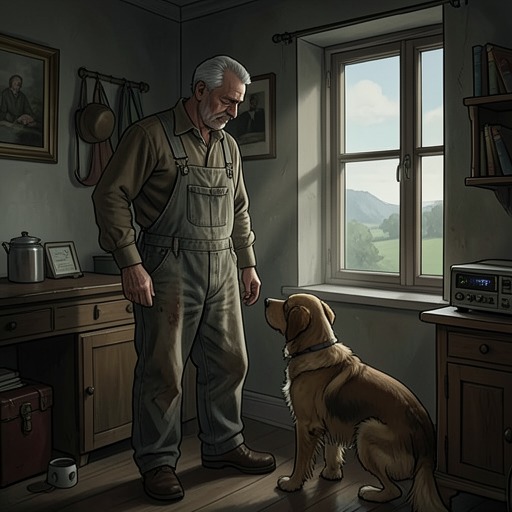
Six-Thirty’s protective bond with Madeline Zott
Lessons in ChemistrySix-Thirty’s protective bond with Madeline Zott grows from his immediate welcome of her into the household into a steady practice of watching over her, listening to her, and occupying a place in her understanding of family. His care is concrete: he blocks hazards and cushions her falls. It is also reciprocal in a quieter way, as he attends to her babbling and becomes part of the family she can name for herself.
A Welcome Into the Household
When Madeline arrives, Six-Thirty greets her as a new member of his family. He has been worried about her, and Elizabeth Zott notes that the time is nine twenty-two and that he has gone more than twenty-four hours without eating. His excitement is expressed in a welcome that includes an offer of chalk. The scene gives the dog a perspective on family membership: just as his own name commemorates the precise time he and Elizabeth became a family, he names the baby Nine Twenty-Two, marking the moment she joins them.
The welcome does not make the transition effortless. After Elizabeth, Madeline, and Six-Thirty enter the house together, the atmosphere briefly seems joyful, especially after Calvin Evans’s death; ten minutes later, Madeline’s crying disrupts that fragile calm. The juxtaposition keeps the bond from being a simple picture of domestic harmony. Six-Thirty’s place beside the new baby begins amid grief and the ordinary strain of caring for a newborn, and his attachment is expressed through continued presence rather than an uninterrupted idyll.
Protection as Daily Practice
As Madeline becomes mobile, Six-Thirty’s care takes the form of repeated, practical interventions. She reaches for dangerous objects and climbs the bookshelf nearly every day. He sniffs out danger, blocks electrical outlets, and places himself beneath the bookshelf so that he can break her fall. The narration links this vigilance to his memory of having once failed to protect someone he loved: he will not fail again. His protectiveness is therefore both a routine response to Madeline’s immediate risks and a resolve shaped by an earlier loss.
The household’s contrasting approaches make the dog’s role especially visible. Harriet Sloane warns Elizabeth that she cannot let Madeline do whatever she wants. Elizabeth, occupied with three test tubes, answers that she has moved the knives. The exchange does not suggest that Six-Thirty replaces adult care; instead, it shows him functioning within a household where Elizabeth’s scientific work and Madeline’s curiosity coexist with real dangers. His body becomes an additional safeguard, positioned where the child is most likely to fall.
Attention and Early Communication
Six-Thirty is not only Madeline’s guard but also an attentive companion. Elizabeth reads aloud to both the child and the dog, resisting Harriet’s preference for abridged books because she believes Madeline and Six-Thirty enjoy the complete versions. Harriet sometimes wishes the dog could talk to Elizabeth, thinking Elizabeth would listen to him. Six-Thirty’s response makes a distinction between speaking and being heard: he understands that Elizabeth does listen, even though their communication is not conversation. He also recognizes that people often ignore dogs, turning his newly learned word for the behavior into a playful reflection on ignorance. His vocabulary has reached 497 words, a measure of how actively he interprets the household around him.
Madeline’s own early communication develops in his presence. Elizabeth once finds her sitting upright in her crib, earnestly explaining something to Six-Thirty in a stream of consonants and vowels. He stands beside the crib with his nose between the slats, following each syllable with his ears. The scene presents their bond as a form of attention before shared spoken language: the baby talks with conviction, and the dog listens as though what she says matters. His attentiveness makes him a participant in her early social world, not merely a watchful presence at its edge.
Family Beyond Biological Ties
Madeline’s sense of Six-Thirty as family becomes explicit when she brings Reverend Wakely what she calls a family picture. It is the Calvin Evans funeral clipping, showing Elizabeth and the dog watching as Calvin’s coffin is lowered into the earth. Madeline explains that Elizabeth is her mother, Six-Thirty is there, she herself was inside her mother, and her father is in the box. The account places the dog within the family image alongside her parents, while also giving her a clear, child’s way of locating herself in a photograph taken before her birth.
Wakely tries to help Madeline express a view of kinship that does not fit neatly into a family tree, comparing people with members of the animal kingdom rather than the plant kingdom. Madeline recognizes his explanation as exactly what she had been trying to tell Mrs. Mudford. In that exchange, Six-Thirty’s presence is not a metaphor imposed from outside the family: Madeline has already included him in her own account of who belongs. The bond’s significance rests on that combination of lived care and recognized membership. He protects her in the rooms where she grows up, listens while she learns to communicate, and appears in the family picture she chooses to show as evidence of her home.